Two operational questions decide whether check presenters help or hurt your service, and most restaurants get both wrong at the point of ordering. The first is how many to stock, because running short during a Friday rush means a server is hunting for a clean holder while a paid table waits. The second is how long they will actually last, because the wrong material turns grubby or starts peeling within a season and quietly makes the room look tired. Here is how to size the order and how to plan the replacement cycle so you buy the right number once and reorder on your terms rather than in a panic.
Start with your table count, then add a buffer
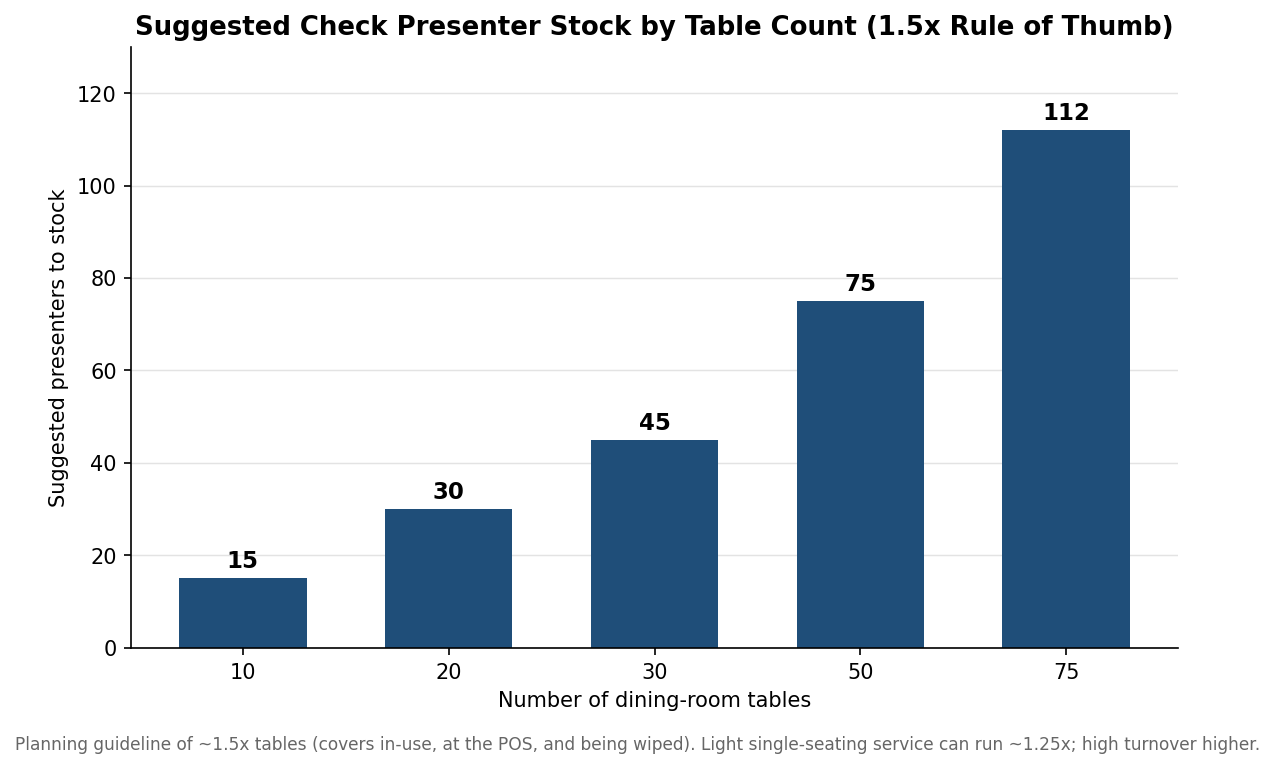
The mistake is buying one presenter per table. At any given moment during service a presenter is in one of several places: dropped at a table that is paying, being wiped and re-penned at the server station, staged in a stack waiting to go out, or sitting damaged and pulled from rotation. Buy exactly one per table and you are always a few short of covering all of those states at once. A workable planning figure is roughly 1.5 times your table count, which gives a rotation buffer without overbuying. A 30-table room lands near 45 presenters, a 50-table room near 75, and so on. Lighter operations that seat once and turn slowly can run closer to 1.25 times, while anything with fast turnover needs the full buffer or more.
Adjust for turnover, dayparts, and to-go
The multiplier is a starting point, not a final number, and turnover is what moves it. A high-volume spot that flips each table three or four times a night cycles presenters far faster than the wipe-and-restock step can keep up with, so it needs more units in the pool to absorb the churn. Running distinct dayparts pushes the number up again — a place that does a heavy lunch and a heavy dinner effectively needs enough presenters to cover a rush twice with cleaning in between. Patios and overflow sections that only open on busy nights still need their own allocation on those nights, and if servers hand a presenter to guests taking the check to a to-go or bar area, assume a share will walk off or come back damaged. Add those realities on top of the base 1.5 times figure rather than hoping the buffer absorbs them.
What running short actually costs
It is worth being concrete about why the buffer matters, because the cost of underbuying is invisible until a rush. When the clean pool runs out, a server either waits at the station for one to be wiped or improvises with a bare printed check or whatever folder is nearby, and both happen at the worst possible moment: the guest is ready to pay and the table is ready to turn. A few minutes lost per table at the payment step, multiplied across a busy night, is real seating capacity left on the floor. Worse, a short pool quietly pressures the floor to keep cracked or stained holders in service rather than pull them, so running short does not just slow service, it also drags down the look of the room. The buffer is cheap insurance against both.
How long each material lasts under heavy use
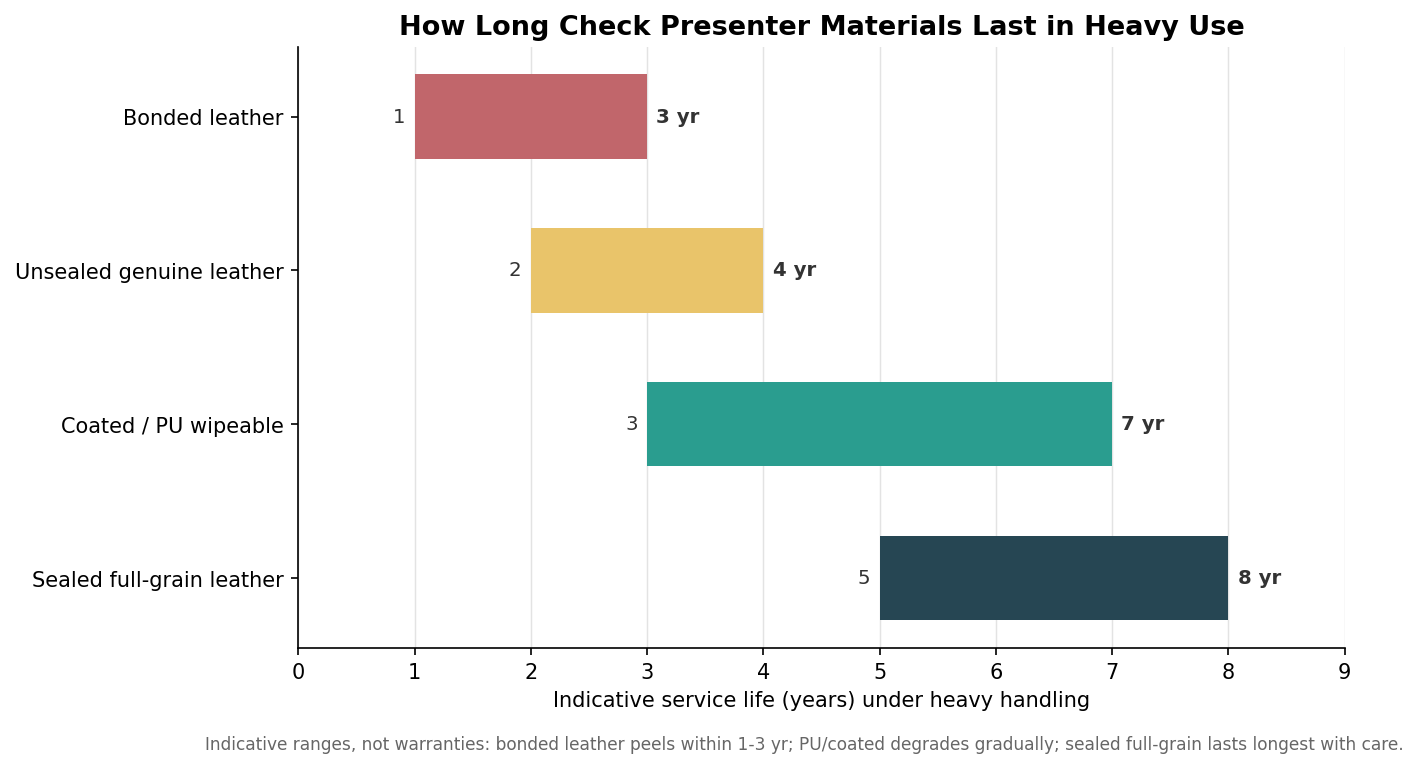
Quantity is only half the budget; replacement rate is the other half, and it is set almost entirely by material. Bonded leather is the cheapest to buy and the most expensive to own, because it is made from leather scrap fused to a backing and it fails suddenly — fine cracks show at the folds and corners within roughly six to eighteen months of hard handling, and surface peeling accelerates from there, typically giving one to three years before it looks unacceptable. Coated and PU (polyurethane) materials hold up far better against the two things that kill presenters in a dining room, spills and constant thumbing, and they degrade gradually rather than shredding, so mid-grade coated stock commonly runs three to seven years. Genuine leather lasts a long time structurally, but left unsealed it stains and darkens where hands and card edges touch it, which is the grubby look that makes a good holder read as shabby; sealed or properly finished full-grain resists that and can serve five to eight years or more with light care. The figures below are indicative ranges for heavy use, not warranties — your actual mileage depends on how the presenters are handled, cleaned, and stored.
Build a replacement cycle instead of reacting
Once you know the pool size and the material’s realistic lifespan, replacement stops being a surprise. If a coated presenter lasts around five years in your room, you are retiring and replacing on the order of a fifth of the pool each year, which is a small, predictable line item rather than a sudden full reorder when the whole batch looks tired at once. Set a standard the floor actually enforces: any presenter that is cracked, peeling, stained, or missing its card slot comes out of rotation immediately, because one grubby holder at a four-top undoes the impression the other clean ones create. Keep a handful of spares boxed so a pulled unit is instantly replaced, and fold a modest overage into every reorder so the pool never drifts below the number your service needs. Buying the right quantity in a material that matches how hard your room runs, then rotating on a planned cycle, costs less over three years than repeatedly replacing cheap holders that peel — and it keeps the last thing a guest touches before they leave looking like you meant it.